Allergen Information on Restaurant Menus: A Dubai Owner's Guide
Allergen awareness is no longer optional in Dubai's restaurant industry. With one of the most internationally diverse populations on earth — residents and visitors from over 200 nationalities — diners with allergies, intolerances, and specific dietary requirements make up a significant portion of your customer base. Providing clear allergen information on your menu is both a food safety responsibility and a genuine business opportunity. Restaurants that make allergy-safe dining easy earn fiercely loyal, repeat customers who recommend you to everyone they know. This guide walks you through everything you need to know as a Dubai restaurant owner: the major allergens, UAE regulatory expectations, and how to implement allergen tagging on your menu without adding complexity or cost.
The 14 Major Allergens Every Dubai Restaurant Should Know
Internationally, food safety authorities recognise 14 major allergens that account for the vast majority of allergic reactions. These are the same allergens identified by the European Union's Food Information for Consumers Regulation, and UAE food safety standards increasingly align with this list. Every restaurant in Dubai should be aware of and prepared to communicate about all 14:
- Gluten — found in wheat, barley, rye, and oats. Present in bread, pasta, many sauces, and numerous unexpected places like soy sauce and some spice blends.
- Crustaceans — shrimp, crab, lobster, crayfish. Common in seafood dishes, bisques, and some Asian sauces.
- Eggs — present in baked goods, pasta, mayonnaise, some sauces, and many desserts.
- Fish — all species. Also found in Worcestershire sauce, Caesar dressing, and some Asian condiments like fish sauce.
- Peanuts — one of the most common and potentially severe allergens. Found in satay sauces, many Asian and African dishes, and some desserts.
- Soybeans — present in soy sauce, tofu, edamame, and widely used as an ingredient in processed foods and cooking oils.
- Milk and dairy — including lactose and casein. Found in butter, cream, cheese, yoghurt, and many baked goods and sauces.
- Tree nuts — almonds, cashews, walnuts, pistachios, hazelnuts, pecans, macadamias, and Brazil nuts. Common in Middle Eastern cuisine, baklava, pesto, and many desserts.
- Celery — including celeriac. Found in stocks, soups, salads, and some spice mixes.
- Mustard — present in dressings, marinades, sauces, and spice blends.
- Sesame — seeds and oil. Extremely common in Middle Eastern cuisine including hummus, tahini, bread, and many dressings.
- Sulphites — used as preservatives in dried fruits, wine, some juices, and pickled foods.
- Lupin — a legume found in some flours and baked goods, increasingly used as a protein supplement.
- Molluscs — mussels, clams, oysters, squid, and octopus.
Why these 14 specifically? They are responsible for approximately 90% of all food allergic reactions globally. While individuals can be allergic to virtually any food, these 14 categories represent the most common and most clinically significant allergens. For a Dubai restaurant serving an international clientele, awareness of all 14 is essential — your guests from Europe, in particular, will expect this level of detail because it is already mandatory in their home countries.
UAE Food Safety Requirements
The UAE takes food safety seriously, and the regulatory landscape around allergen disclosure is evolving. Here is what Dubai restaurant owners need to understand about the current framework and where it is heading.
The UAE Federal Law No. 10 of 2015 on Food Safety establishes the overarching framework for food safety across the Emirates. This law empowers local authorities — including Dubai Municipality — to set specific requirements for food establishments. The Emirates Authority for Standardization and Metrology (ESMA) sets national standards for food labelling, which increasingly include allergen disclosure requirements for pre-packaged foods.
For restaurants specifically, Dubai Municipality's Food Safety Department requires that food establishments maintain awareness of allergens in their products and be able to communicate this information to customers upon request. Current requirements include:
- Food handlers must be trained in allergen awareness as part of their food safety certification.
- Restaurants must be able to provide allergen information to diners who ask.
- Pre-packaged foods sold by restaurants must comply with UAE labelling standards, which include allergen declarations.
- Buffet and catering operations face additional requirements around allergen identification.
The clear trend is toward mandatory allergen disclosure on menus, following the model already established in the EU, the UK, and Australia. The UAE's food safety framework regularly adopts international best practices, and full menu-level allergen disclosure is widely expected to become a requirement in the near future.
The smart approach for Dubai restaurant owners is to get ahead of tightening regulations rather than scramble to comply after the fact. Implementing allergen tagging on your menu now means you are already compliant when requirements become mandatory — and you gain a competitive advantage in the meantime.
Important note: This article provides general guidance and should not be treated as legal advice. For specific compliance requirements applicable to your establishment, consult Dubai Municipality's Food Safety Department directly.
Why Paper Menus Fail at Allergen Communication
If you are considering simply adding allergen information to your existing paper menus, you will quickly run into a set of practical problems that make this approach unreliable. As explored in our comparison of digital versus paper menus, physical menus have inherent limitations — and allergen communication exposes every one of them.
Space constraints create clutter. A typical dish description on a paper menu is two to three lines. Adding allergen information — potentially listing five or six allergens per dish — doubles the text. Multiply that across 40 or 50 menu items, and your menu becomes an overwhelming wall of small print that nobody reads.
Symbol systems are inconsistent and confusing. Many restaurants attempt to solve the space problem by using small icons or letter codes (G for gluten, N for nuts, D for dairy). But there is no universal standard. A triangle might mean "contains nuts" at one restaurant and "spicy" at the next. Diners with serious allergies cannot afford to guess what your symbols mean.
Recipe changes require reprinting. When your chef changes a sauce recipe, swaps a supplier, or introduces a seasonal special, the allergen information on your printed menu is instantly outdated. Reprinting menus every time an ingredient changes is expensive and impractical — so most restaurants simply do not do it, leaving incorrect allergen information in diners' hands.
Staff knowledge gaps create risk. When a diner asks a server about allergens, the server often does not know the full ingredient list of every dish. They check with the kitchen, the kitchen is busy, and the answer that comes back may be incomplete. This is not a criticism of staff — it is an unreasonable expectation to place on memory alone.
Outdated information creates liability. If a diner has an allergic reaction based on incorrect allergen information on your menu, you face potential legal liability. A paper menu that was accurate three months ago but is not accurate today is a risk that no restaurant owner should accept.
How Digital Menus Transform Allergen Communication
Digital menus solve every one of the problems outlined above. They do not just add allergen information — they fundamentally change how that information is structured, displayed, and maintained.
Allergens are tagged at the data level. Each dish in a digital menu system is tagged with its specific allergens as structured data, not as text squeezed into a description. This means the information is precise, consistent, and machine-readable.
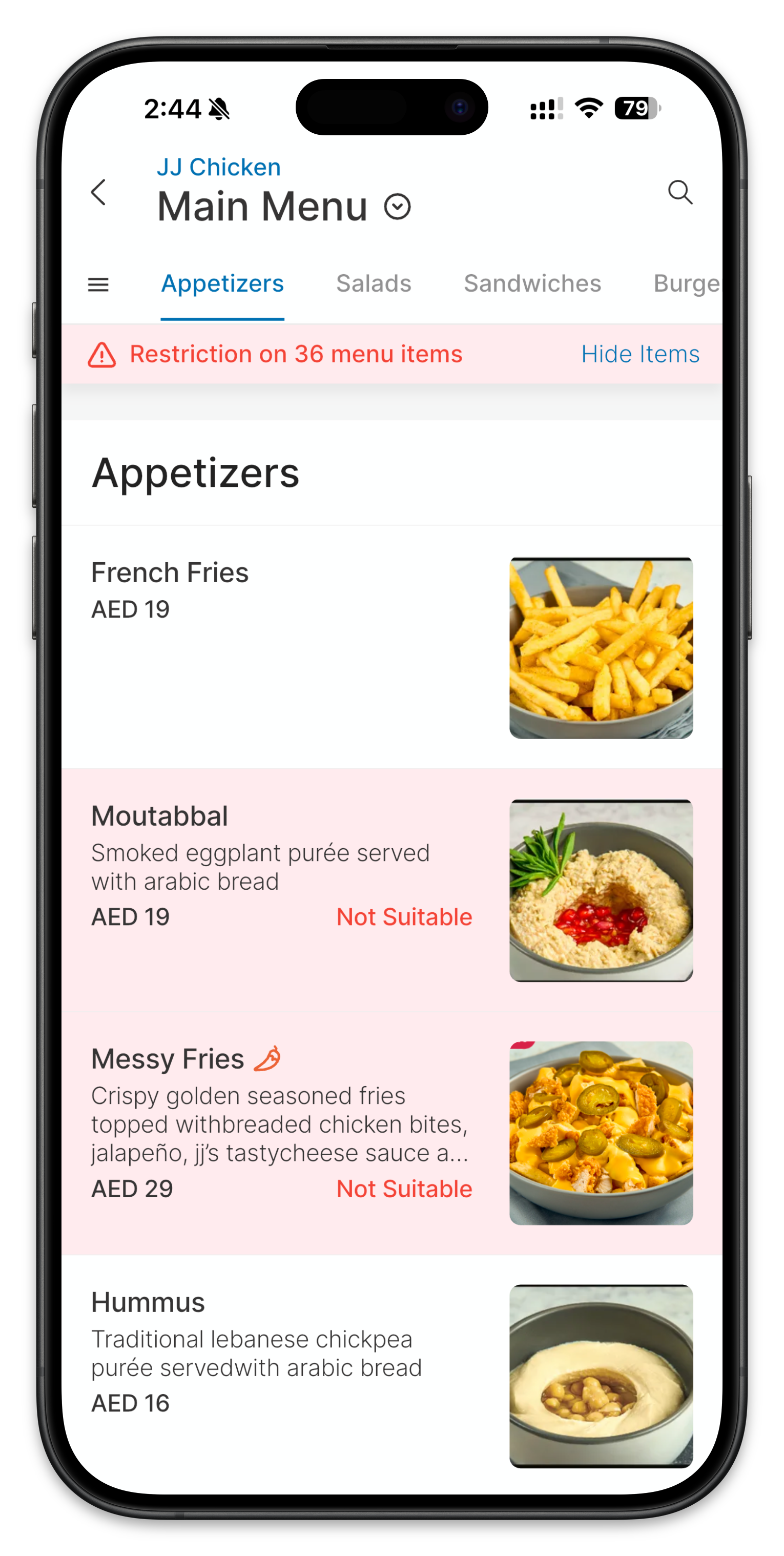
Diners can filter by their allergy. Instead of scanning every item on the menu and reading fine print, a diner with a nut allergy can simply filter the entire menu to show only nut-free options. This is a completely different experience from squinting at symbols on a paper menu — it is fast, clear, and confidence-inspiring.
Icons and labels are consistent and clear. A well-designed digital menu uses standardised icons and labels across every dish. There is no ambiguity about what a symbol means because it is accompanied by a clear text label.
Updates happen in real time. When a recipe changes, you update the allergen tags in the system and every diner sees the correct information immediately. No reprinting, no lag, no outdated menus sitting on tables.
The menu does the informing, reducing staff burden. Your servers no longer need to memorise allergen information for every dish. The digital menu provides the detail, and staff can focus on hospitality. This also reduces the training required for new team members.
You have an audit trail. A digital system records what allergen information was displayed and when. If a question ever arises about what a diner was told, you have a clear record — something a paper menu cannot provide.
Setting Up Allergen Tags on Places UAE
Places UAE's free digital menu includes allergen and dietary tagging as a built-in feature — not a premium add-on. Here is how it works in practice.
When you add or edit a menu item in the Places system, you can tag it with multiple allergen and dietary labels. The standard tags available include:
- Dietary preferences: vegan, vegetarian, pescatarian
- Allergen-free labels: gluten-free, nut-free, dairy-free, egg-free
- Other dietary indicators: halal, organic, sugar-free
- Spicy levels: mild, medium, hot
- Custom tags: available for any specific needs your restaurant has
These tags display clearly alongside each dish's name and photo, so diners can see at a glance what a dish contains or avoids. There is no ambiguity and no need to ask a server for clarification.
Because Places UAE serves Dubai's multilingual market, allergen information displays in both English and Arabic. This is critical in a city where your diners — and your staff — may be more comfortable in either language. A bilingual allergen display removes language as a barrier to food safety.
The entire allergen tagging feature is part of the free digital menu. There is no extra charge for adding dietary or allergen labels to your dishes, no limit on the number of tags per item, and no premium tier required to access the filtering feature for diners.
Best Practices for Allergen Management
Having allergen information on your menu is essential, but it is only one part of a broader allergen management approach. Here are practical steps every Dubai restaurant should implement:
Kitchen and Staff Practices
- Train all kitchen staff on cross-contamination. A dish may be nut-free by recipe, but if it is prepared on the same surface as a dish containing nuts without proper cleaning, it is not truly nut-free. Cross-contamination training should be part of every kitchen employee's onboarding.
- Designate an "allergen contact" for each shift. One staff member per shift should be the go-to person for allergen questions. This person should know the menu's allergen profile thoroughly and be empowered to check with the kitchen when needed.
- Maintain a master ingredient list for every dish. Every recipe in your kitchen should have a documented ingredient list that includes sub-ingredients (for example, if a sauce contains soy, that should be noted even if soy is not a primary ingredient of the dish). This document is your single source of truth for allergen tagging.
Menu and Communication Practices
- When in doubt, flag the allergen. If you are not 100% certain a dish is free from a particular allergen, tag it as containing that allergen or use a "may contain" warning. It is always better to over-disclose than to under-disclose. A diner who avoids a dish unnecessarily is far better than a diner who has an allergic reaction.
- Update your digital menu immediately when recipes change. The moment a recipe is modified — even a minor change like a different brand of cooking oil — review and update the allergen tags. Digital menus make this instant, so there is no excuse for delay.
- Use "may contain" warnings for shared preparation areas. If your kitchen prepares dishes containing peanuts and also prepares dishes that should be peanut-free, add "may contain peanuts" to items prepared in the shared area. This is honest, protects your diners, and reduces your liability.
- Communicate proactively, not just reactively. Do not wait for diners to ask about allergens. Make the information visible and accessible — your digital menu handles this automatically.
The Business Case for Allergen Transparency
Beyond food safety and compliance, there is a compelling commercial argument for making allergen information a priority. Restaurants that get this right see tangible business benefits.
Allergy sufferers are among the most loyal customers you will ever have. Finding a restaurant where they feel genuinely safe is not easy. When they find one, they return again and again — and they tell everyone. Word of mouth from the allergy community is powerful because the need is so personal and the stakes are so high.
Families with allergic children choose restaurants based on allergen info. A family with a child who has a peanut allergy does not browse menus casually. They research in advance, and they choose the restaurant that clearly communicates its allergen information. If your menu does not provide this, you lose the entire family — not just the allergic child.
Allergen-aware dining is a growing search category. Gluten-free restaurants in Dubai, vegan dining options, and allergy-safe restaurants are among the fastest-growing search terms in the food and dining space. Diners are actively looking for restaurants that cater to their needs. Being discoverable for these searches drives new customers through your door.
Allergen transparency reduces incident risk and liability. An allergic reaction at your restaurant is a serious event — for the diner, for your staff, and for your business. Clear allergen communication, proper kitchen practices, and a documented system significantly reduce the likelihood of an incident and demonstrate due diligence if one does occur.
Positive reviews mentioning allergy safety drive new business. When a diner leaves a Google or TripAdvisor review saying "We felt completely safe dining here with our daughter's nut allergy — the menu clearly showed which dishes were safe," that review becomes one of your most powerful marketing assets. It speaks directly to other allergy-affected diners and signals a level of care that resonates with all customers.
Frequently Asked Questions
Am I legally required to list allergens on my menu in Dubai?
UAE food safety regulations are evolving, and the trend is clearly toward mandatory allergen disclosure on restaurant menus. Currently, Dubai Municipality requires that restaurants be able to provide allergen information upon request and that food handlers are trained in allergen awareness. While full menu-level allergen labelling is not yet universally mandated for dine-in menus, it is widely considered best practice — and the direction of regulation strongly suggests it will become mandatory. Getting ahead of this requirement is both smart compliance and good business. Consult Dubai Municipality's Food Safety Department for the specific requirements applicable to your establishment.
What if I am not sure about allergens in a dish?
If you are uncertain whether a dish contains a particular allergen, flag it as "may contain" until you can verify with your suppliers. Never guess. Contact your ingredient suppliers for detailed allergen information, and document what you learn. Many suppliers can provide allergen certificates for their products. Until you have confirmed information, the safest approach is to disclose the potential presence of the allergen.
Does Places UAE help identify allergens in my dishes?
Yes. When you set up your free digital menu on Places UAE, the team can guide you through the allergen tagging process based on your ingredient lists. You provide the ingredients for each dish, and the system makes it straightforward to apply the correct allergen and dietary tags. The tagging interface is designed to be intuitive, but support is available if you need help getting started.
How do I handle cross-contamination warnings on my digital menu?
For items prepared in shared kitchen areas where cross-contamination is possible, add "may contain" notes to the relevant dishes. For example, if your kitchen uses the same fryer for both battered fish (contains gluten) and chips that you would otherwise list as gluten-free, those chips should carry a "may contain gluten" tag. Places UAE's tagging system supports these nuanced warnings, allowing you to be transparent about preparation conditions without removing items from allergy-filtered results entirely.
Get Started with Allergen Tagging Today
Adding allergen information to your restaurant's menu is one of the highest-impact, lowest-cost improvements you can make. It protects your customers, reduces your risk, positions you ahead of upcoming regulations, and builds the kind of trust that turns first-time visitors into loyal regulars. With Places UAE's free digital menu, allergen tagging is built in from day one — no extra cost, no complicated setup, and fully bilingual in English and Arabic. Set up your menu, tag your dishes, and give your customers the confidence to dine with you again and again.
Get Your Free Digital Menu on Places UAE
Join the Places cashback network and your digital menu is included. No subscription.
Get Your Free Digital Menu