Places UAE vs Google Maps: Which Is Better for Dining in Dubai?
Google Maps is the default restaurant finder for most people. It is installed on virtually every smartphone, it has years of review data, and it is familiar. But is it actually the best tool for finding restaurants in Dubai? We put Places UAE search head-to-head against Google Maps across five real-world dining scenarios to find out.
The Test Setup
We ran five different restaurant searches on both platforms, evaluating the results based on relevance, accuracy, depth of information, and overall usefulness. All searches were conducted in Dubai during March 2026.
Scenario 1: Simple Cuisine Search — "Thai food near Dubai Marina"
Google Maps Result
Google Maps returned a list of approximately 20 Thai restaurants near Dubai Marina, sorted primarily by proximity and review count. Each listing showed the restaurant name, star rating, number of reviews, price level ($ to $$$$), and address. Clicking through to each listing provided photos, reviews, and basic information like phone number and opening hours.
Places UAE Result
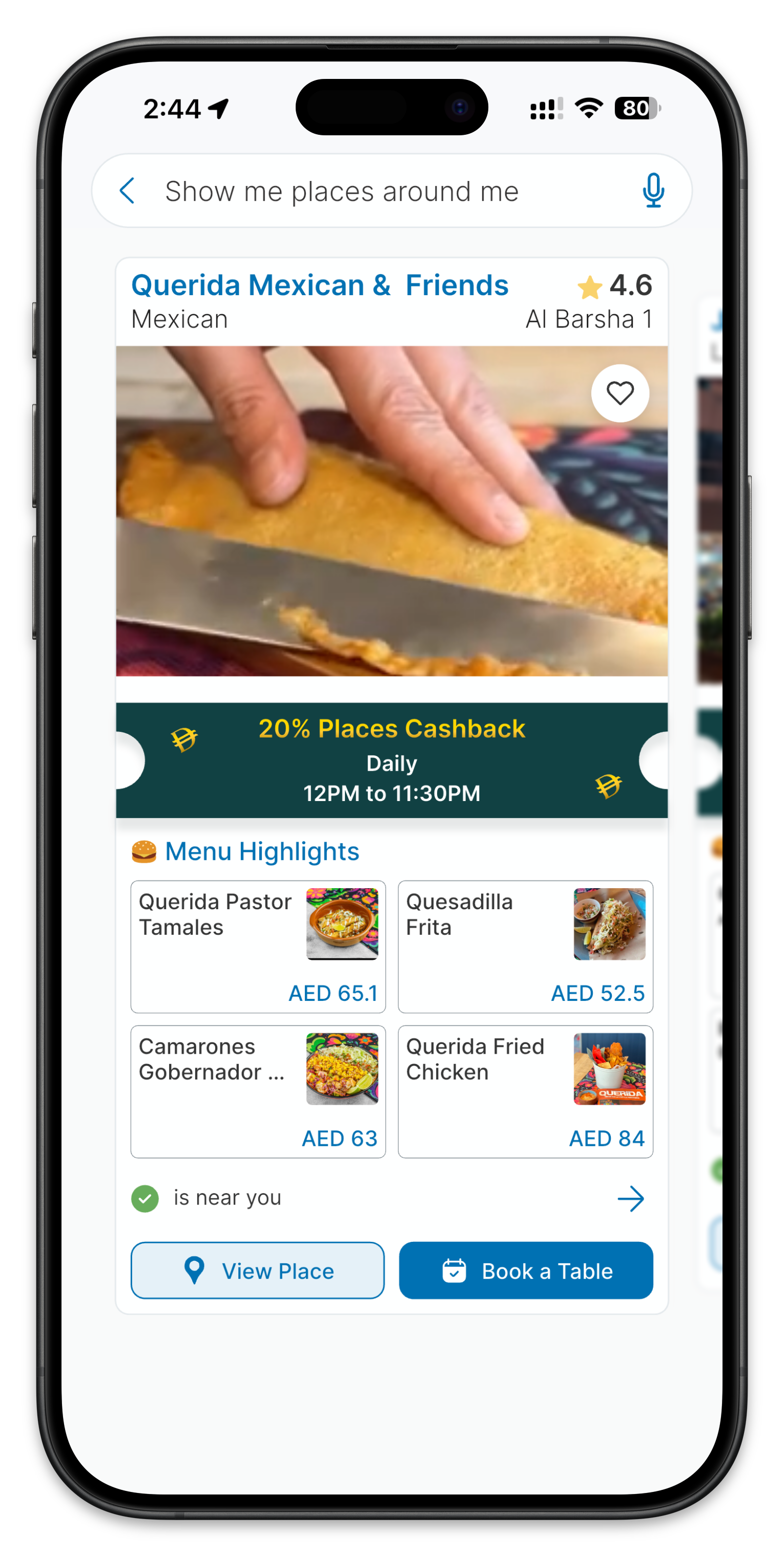
Places UAE returned a curated list of Thai restaurants, also sorted by proximity but with several additional layers of information visible immediately. Each listing showed the menu highlights, specific Thai dishes available, cashback percentage, price range for popular items, and dietary labels. The AI also distinguished between authentic Thai restaurants and fusion restaurants with Thai-influenced items on a broader menu.
Verdict
For a simple search, both platforms perform adequately. Google Maps has the edge in total number of listings (including small, unverified eateries), while Places UAE provides richer per-restaurant information. If you just want the nearest Thai restaurant, Google Maps is fine. If you want to know which one serves the best pad thai and what it costs, Places UAE wins.
Scenario 2: Dietary Requirement — "Gluten-free Italian restaurant in Downtown"
Google Maps Result
Google Maps does not have a native gluten-free filter for restaurant search. We searched "gluten-free Italian restaurant Downtown Dubai," which returned a mix of Italian restaurants (some of which might have gluten-free options) and dedicated gluten-free or health-focused restaurants (which might not serve Italian food). The results required significant manual checking of individual menus and reviews to determine which restaurants genuinely offered gluten-free Italian dishes.
Places UAE Result
Places UAE understood the query as a three-part request: Italian cuisine + gluten-free requirement + Downtown location. It returned restaurants in Downtown Dubai that serve Italian food and have confirmed gluten-free items on their menu. Each result showed specific gluten-free Italian dishes available, including pricing and allergen information. One restaurant flagged that it uses a shared kitchen but has dedicated preparation procedures for gluten-free orders.
Verdict
Places UAE wins decisively. The ability to search at the dish level rather than the restaurant level makes dietary-requirement searches dramatically more useful. With Google Maps, you would spend 20 minutes calling restaurants and reading reviews to get the same information Places UAE delivers in seconds.
Scenario 3: Complex Social Situation — "Restaurant for 6 people, one vegan, celebrating a birthday, under AED 200 per person"
Google Maps Result
Google Maps cannot process this as a single query. We had to break it down into multiple separate searches and manually cross-reference results. Searching for "birthday restaurants Dubai" returned popular celebration venues but without budget filtering or dietary consideration. There was no way to verify which restaurants could accommodate a group of six with adequate vegan options within the budget without individually checking each listing.
Places UAE Result
Places UAE processed the entire query at once. It returned restaurants that: accommodate parties of six, have a genuine vegan section on the menu (not just one token option), fall within the AED 200 per person budget based on actual menu prices, and are known for being good birthday celebration venues (some offering complimentary birthday cakes or special touches). Each result included a breakdown of typical per-person costs for a full meal.
Verdict
This is where AI-native search pulls far ahead. The ability to handle multiple constraints simultaneously saves enormous time and produces results that are genuinely fit for purpose. Google Maps would require substantial manual research to achieve a comparable result.
Scenario 4: Value-Optimised Search — "Best cashback deals on seafood this weekend"
Google Maps Result
Google Maps has no concept of cashback. Searching for this returns generic results about seafood restaurants, with no integration of cashback offers, loyalty programmes, or value-optimisation features. You would need to cross-reference a separate deals platform with Google Maps results.
Places UAE Result
Places UAE returned seafood restaurants with active cashback offers, sorted by effective value (combining food quality with cashback percentage). The results highlighted weekend-specific boosted cashback rates and showed the effective price of popular dishes after cashback. One restaurant offered 35% cashback on weekend dinners, making a premium seafood platter effectively cost 65% of its listed price.
Verdict
Places UAE wins by default since Google Maps does not offer cashback integration. But beyond simply having the feature, the ability to optimise restaurant discovery based on value, combining quality ratings with financial savings, is a genuinely powerful capability.
Scenario 5: Exploration — "Surprise me with something new I haven't tried"
Google Maps Result
Google Maps has no mechanism for this type of query. It does not track what you have tried, cannot personalise recommendations based on your history, and does not understand the concept of "surprising" you with something outside your usual preferences.
Places UAE Result
Places UAE drew on the test user's dining history (six months of recorded visits) and identified cuisine types and neighbourhoods not yet explored. It suggested a Georgian restaurant in Al Barsha (a cuisine the user had never tried), an Peruvian-Japanese fusion spot in DIFC, and a newly opened Eritrean cafe in International City. Each recommendation included an explanation of why it was suggested and how it differed from the user's usual choices.
Verdict
Places UAE wins convincingly. The ability to push users beyond their comfort zone in an intelligent, personalised way is something no traditional search platform can offer. This is search at its most valuable, not just finding what you know you want, but helping you discover what you did not know you wanted.
Overall Assessment
Google Maps remains a solid general-purpose tool for quick, simple restaurant lookups. If you want to find the nearest pizza place or check a restaurant's opening hours, it does the job well. But for the complex, nuanced, and personalised dining decisions that Dubai's diverse food scene demands, Places UAE's search is in a different league.
The fundamental advantage is data depth. Google Maps works with restaurant-level information: name, location, rating, price range. Places UAE works with dish-level, real-time, personalised information: specific menu items, precise prices, allergen data, cashback rates, and individual dining history. That depth of data, combined with AI that can process complex multi-criteria queries, delivers a search experience that Google Maps was never designed to match.
Get Cashback at 190+ Dubai Restaurants
Pay your bill through the Places app and up to 50% comes back as cashback credit. No coupons, no vouchers. Free to download.